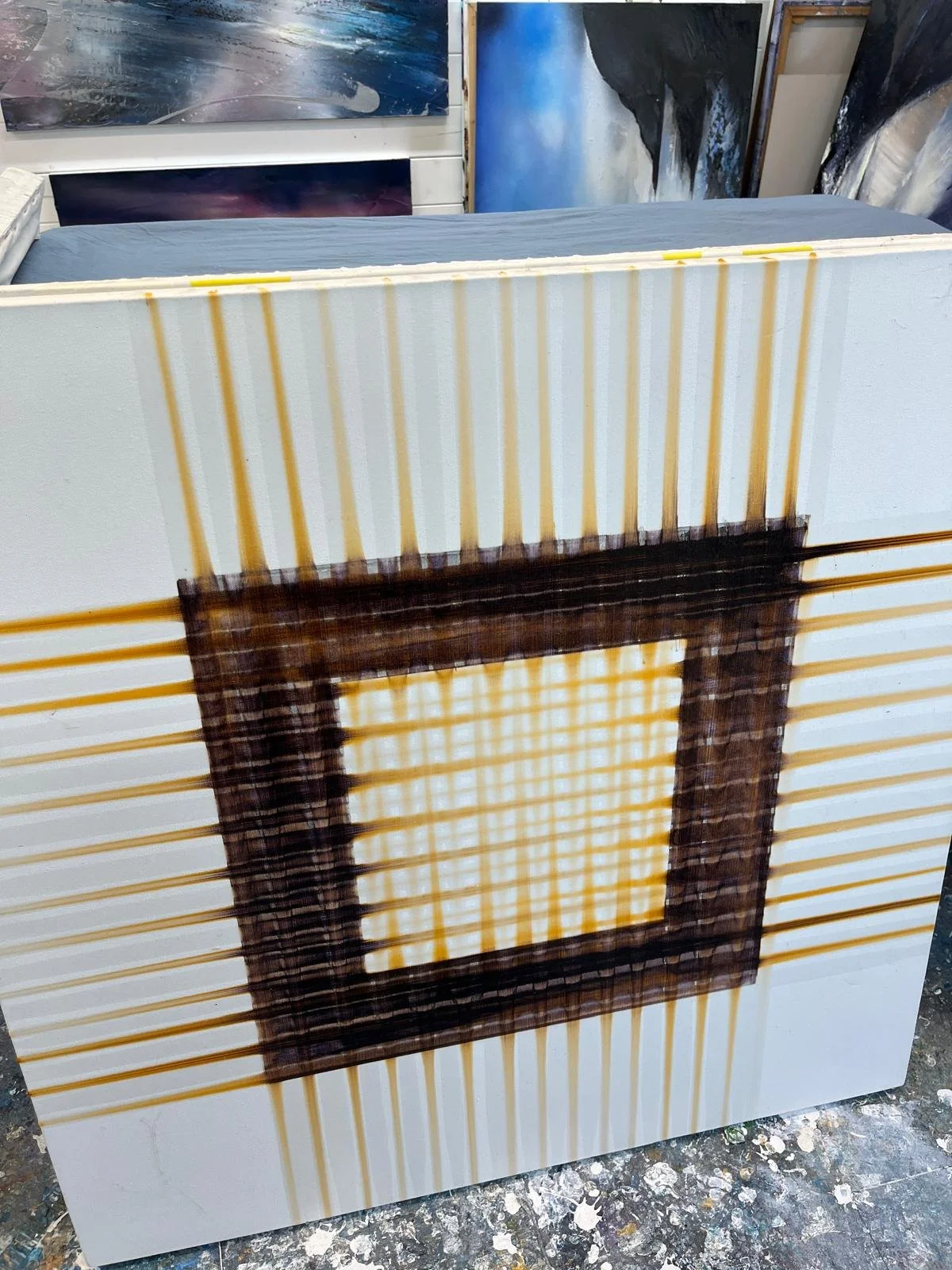
I pulled this piece out of storage recently. I painted it back in 1999, after my MFA degree show, and it's just come back into my possession after sitting with someone else for over two decades. Looking at it again reminded me how much of what I still do today started right here.
Buy “Transition 1999” →
Process, not subject
At the time, I was completely absorbed in process-based painting. The question I was asking myself wasn't "what am I painting?" but "what happens if I manipulate this medium in a particular way, and how does that translate to the viewer?" Landscape, or any recognisable subject, wasn't the starting point at all. The process was the subject.
I was looking closely at artists working in that territory: Callum Innes, whose work treats the act of making as the content of the painting rather than a means to an end; Fiona Rae; and Ian McKeever. Ian actually taught me during my MFA. They were all, in their own ways, interested in manipulating mediums and letting the painterly effects do the talking.
Why chromatography
What made this particular piece unusual was the technique. Not many artists were using chromatography in painting at the time. There were one or two, but I was among the rare ones experimenting with it on canvas, and it was almost unheard of. The pattern you can see, the way colour bleeds and separates as it moves through the fibres, comes from that chromatographic process.
The materials were simple, in the end: Quink ink and a white spirit solution, plus acrylic and glue, applied by pouring. That was it. Ink, acrylic, white spirit and pouring, that combination was the whole technique.
I was surprisingly open about it at the time, more than the norm. This was many, many years before social media existed in any meaningful way, and when Facebook first came along I remember being told off by galleries for talking so freely about the products I used. Nobody else was putting this kind of technique onto canvas, so it wasn't really the done thing to explain how it was made. It feels strange now, looking back, given how openly artists share process today.
Barcelona, and the teachers who shaped it
This work came directly out of my time at Winchester School of Art, where part of my Master's was spent studying in Barcelona through a partner arrangement with a school just down the road from the Picasso Museum. It was a remarkable place to be based. I was taught by Ian McKeever and Barbara Rae, among others, and I was looking hard at artists like Antoni Tàpies and Miró, who in the 1950s were making huge, expressive paintings that weren't just about being looked at. They were about how a viewer experiences paint physically, in the room, in front of the work.
That idea has never left me. You don't just look at a painting; you experience it. Paintings are not just to be seen, they're to be felt. That's really where my visual language began, and it's the same conviction that still sits behind everything I make now, over two decades later.
This is really why the piece matters to me. Process-based painting was so important during my Master's because it was about building my own unique visual language, and that was the beginning of it. Part of what makes a Master's degree in fine art so valuable is that you're constantly learning and constantly self-critiquing, so that you make a piece of work, critique it honestly, and let it develop from there. You don't just keep regurgitating the same thing. You push your own visual language forward. That's one of the most important things in fine art painting, and it's exactly what I was doing with Callum Innes and Ian McKeever in mind, where process becomes the subject rather than the subject itself being the important part of the painting.
STILL PUSHING THE BOUNDARIES
A lot of work from that period (and since) found buyers, my degree show sold out completely, but this particular piece was gifted rather than sold, and one of the reasons I think I'm still doing this, still in the art industry, is that I've never stopped trying different things. I'm always pushing at the edges of what a medium can do, even now.
Over 25 years on, it's strange and rather grounding to look at where it started.
Interested in the story behind a particular piece, past or present? Get in touch, I'm always happy to talk process.